Modern sports venues require more than quality playing surfaces and well-planned layouts; they also need reliable illumination that supports safety, visibility, performance, and comfortable viewing. Sports facility lighting plays an important role in determining how clearly players can follow fast-moving action, how comfortably spectators can watch games, and how effectively a venue can operate after daylight hours. A properly planned lighting system distributes illumination across the playing area while reducing harsh shadows, excessive brightness, and distracting glare.
The design must also consider the type of sport, court or field dimensions, mounting positions, fixture performance, and expected level of use. LED technology has become a popular option because modern fixtures can provide strong illumination with comparatively efficient energy consumption and long service life. Indoor facilities have different requirements from outdoor fields because ceiling height, structural arrangements, ventilation, and surrounding surfaces influence the lighting design. Outdoor venues additionally need to consider weather exposure, lighting poles, electrical infrastructure, neighboring properties, and unwanted light spill.
Why Proper Lighting Matters in Sports Facilities
Sports facility lighting directly affects the usability and overall experience of a recreational or professional venue. Players need sufficient and consistent illumination to judge distances, track balls, identify teammates, and respond quickly during active play. Uneven lighting can create dark areas or excessive brightness that makes certain parts of a court or field difficult to see. Therefore’ glare can also distract players and spectators, particularly when fixtures are positioned within direct lines of sight.
A well-designed system can help extend operating hours, allowing facilities to accommodate evening training sessions, competitions, and recreational activities. Lighting also contributes to the appearance and functionality of commercial sports facilities, where a comfortable environment can influence how visitors perceive the venue. Energy-efficient fixtures and intelligent controls can further reduce unnecessary electricity consumption during periods when full illumination is not required. For these reasons, lighting design should be coordinated with the architectural, electrical, structural, and operational requirements of the complete sports facility.
Better Visibility for Players
Players need clear visibility throughout the playing area, especially in sports involving fast-moving balls or rapid changes in direction. Consistent illumination helps reduce visual distractions and supports more predictable playing conditions.
Improved Safety
Adequate lighting can make courts, walkways, entrances, changing areas, and surrounding spaces easier to navigate. Good visibility is particularly important for evening activities and facilities with frequent visitor movement.
Better Spectator Experience
Spectators should be able to follow the action without discomfort caused by excessive glare or poorly distributed illumination. Appropriate lighting can improve visibility from different seating positions.
Longer Operating Hours
A professionally planned system allows facilities to remain functional after sunset and can support evening training, competitions, and recreational programs.
Key Factors to Consider in Sports Lighting Design
Designing an effective system involves much more than calculating the number of light fixtures required. Sports facility lighting should be developed around measurable performance requirements, facility dimensions, sport-specific activities, and the intended level of competition. Illuminance, commonly expressed in lux, helps determine how much light reaches the playing surface. Uniformity is equally important because a high average illumination level does not necessarily mean that every area receives consistent light. Designers must also evaluate glare, shadowing, color rendering, fixture optics, mounting height, and aiming angles. The position of each fixture can influence both the quality of illumination and the amount of unwanted light reaching surrounding areas. Indoor venues may require careful coordination with ceiling structures, ventilation systems, suspended equipment, and other building services. Outdoor venues require additional consideration of poles, foundations, weather-resistant fixtures, electrical cabling, and environmental conditions.
Illuminance and Lux Levels
Lux levels should be selected according to the type of sport and the intended use of the facility. Training areas, recreational venues, local competitions, and professional-level facilities may have different illumination requirements.
Lighting Uniformity
Uniformity helps ensure that the playing surface does not contain significant variations between bright and dark areas. Proper fixture distribution and photometric planning are important for achieving balanced illumination.
Glare Control
Glare can occur when players or spectators look directly toward bright fixtures or when light reflects from certain surfaces. Correct fixture positioning, beam control, mounting height, and aiming can help reduce uncomfortable glare.
Color Rendering and Light Quality
Color rendering affects how naturally objects and surfaces appear under artificial light. Good-quality LED fixtures can provide consistent light that supports visual clarity and improves the overall environment.
Choosing the Right LED System for Sports Facilities
LED technology has become an important option for modern sports venues because fixtures can provide high illumination while offering long operating life and flexible control options. The right fixture, however, should not be selected based only on wattage or brightness claims. Beam angle, optical design, mounting height, color rendering, ingress protection, thermal management, and control compatibility can all influence performance. Outdoor installations should use fixtures suitable for exposure to rain, dust, temperature changes, and other environmental conditions. Indoor systems may require different fixture shapes and mounting arrangements depending on ceiling height and the type of sports activity. High-output floodlights are commonly considered for large outdoor grounds, while specialized LED fixtures can be used for indoor courts and smaller playing areas. A professional lighting layout can help determine the number, position, and specification of fixtures before installation begins.
| Fixture Feature | Importance |
| Wattage | Indicates electrical power consumption |
| Beam Angle | Controls the spread of illumination |
| Optics | Helps direct light toward the required area |
| CRI | Supports accurate color appearance |
| CCT | Determines the visual appearance of white light |
| IP Rating | Indicates protection against dust and moisture |
| Lifespan | Influences long-term replacement requirements |
| Controls | Allows dimming, scheduling, and operational flexibility |
Sports Lighting Requirements for Different Facilities
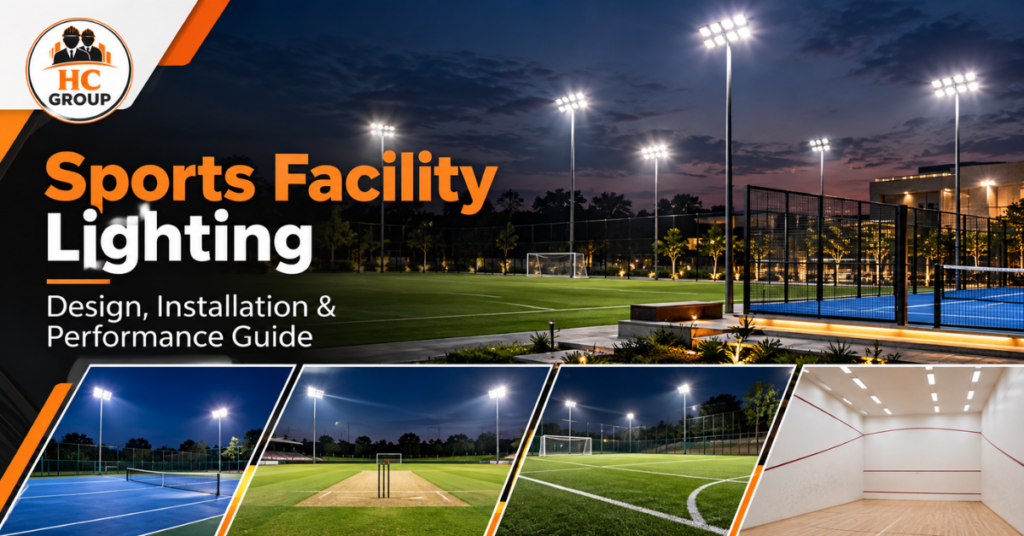
Different sports require different lighting approaches because playing areas, ball speeds, player movement, viewing angles, and facility dimensions vary considerably. Sports facility lighting for a tennis court, for example, needs to provide consistent visibility across the court while minimizing glare during serves and rallies. A cricket ground presents a much larger area and may require carefully positioned high-mast fixtures to cover the field without creating distracting shadows. Futsal and football facilities need illumination that allows players to track fast-moving balls across relatively large playing areas.
Squash courts have enclosed environments where fixture positioning, reflection, ceiling height, and wall surfaces can strongly influence visual comfort. Padel courts require attention to court boundaries, glass panels, player sightlines, and fixture placement. Multi-sport facilities need flexible solutions that can accommodate different activities and operating conditions. The lighting design should therefore be developed around the specific sport and facility rather than applying the same fixture arrangement to every venue.
Tennis Court Lighting
Focus on even illumination across the court, glare reduction, suitable pole positioning, and clear visibility during fast rallies.
Padel Court Lighting
Discuss lighting around the enclosed playing area, glass walls, player sightlines, and fixture placement.
Cricket Ground Lighting
Cover large-area illumination, high-mast systems, field coverage, glare control, and spectator visibility.
Futsal and Football Lighting
Discuss consistent illumination across the playing surface, ball visibility, player movement, and spectator areas.
Squash Court Lighting
Focus on ceiling-mounted or carefully positioned fixtures, reflection control, visual comfort, and uniform illumination.
Indoor vs Outdoor Sports Lighting
Indoor and outdoor venues require different approaches because their physical environments and installation conditions are not the same. Sports facility planning inside a building must work with the ceiling structure, available mounting points, ventilation, electrical systems, and interior finishes. Fixture placement is particularly important because reflective floors, walls, or ceilings can influence perceived brightness and glare. Outdoor facilities have greater exposure to weather and require suitable poles, foundations, cabling, fixtures, and protective enclosures. Outdoor lighting must also be designed to minimize unwanted spill toward nearby roads, homes, commercial properties, or environmentally sensitive areas. Maintenance access is another consideration because fixtures installed at significant heights may require specialized equipment for inspection and replacement. Both environments benefit from efficient LED technology, but the fixture specifications and installation methods should match the operating conditions. A site-specific assessment is therefore essential before selecting equipment or finalizing a lighting layout.
| Factor | Indoor Facility | Outdoor Facility |
| Mounting | Ceiling or structural framework | Poles or masts |
| Weather Exposure | Generally limited | High |
| Fixture Protection | Building environment dependent | Weather-resistant required |
| Light Spill | Primarily internal | External areas must be considered |
| Maintenance Access | Depends on ceiling height | May require lifting equipment |
| Design Challenges | Ceiling, reflections, structures | Wind, weather, poles, surroundings |
Layout, Pole Height and Fixture Positioning
The physical arrangement of lighting equipment has a major effect on the final performance of a sports venue. Sports facility lighting should be positioned so that the required playing areas receive balanced illumination without placing fixtures directly within problematic sightlines. Pole height influences coverage, beam distribution, glare, and the number of fixtures required. Low mounting positions may create stronger glare or shadows, while very high positions can require more powerful fixtures and careful aiming.
Moreover’ designers should consider the dimensions of the playing area, spectator locations, surrounding buildings, and the direction of player movement. Outdoor poles also need suitable foundations and structural planning to withstand environmental loads. Indoor fixtures must be coordinated with roof structures, ceiling systems, ventilation equipment, and other building services. Photometric calculations can help evaluate fixture locations and predict how light will be distributed before physical installation.
Important Layout Considerations
- Playing Area: Identify the complete area that requires illumination.
- Mounting Position: Determine suitable fixture and pole locations.
- Mounting Height: Select a height that supports coverage and glare control.
- Beam Angle: Choose optics that direct light where it is needed.
- Aiming Direction: Position fixtures carefully to avoid direct glare.
- Surrounding Areas: Consider spectator zones, walkways, entrances, and neighboring properties.
- Maintenance Access: Ensure fixtures can be safely inspected and serviced.
Sports Lighting Installation Process
A professional installation should follow the approved design rather than relying on fixture placement based solely on visual judgment. Sports facility lighting installation normally begins with a detailed assessment of the venue, existing electrical infrastructure, playing area, mounting locations, and operational requirements. The design team can then prepare a lighting layout and determine appropriate fixtures, poles, cabling, controls, and electrical components. Structural and civil requirements should be addressed before poles or major equipment are installed.
However’ once the infrastructure is prepared, fixtures can be mounted, connected, aimed, and tested according to the approved layout. Electrical connections should be checked carefully to ensure that the system operates safely and consistently. After installation, lighting levels and distribution should be evaluated to identify areas requiring adjustment. Final commissioning should confirm that the system performs according to the intended design and that operators understand the available controls.
Typical Installation Sequence
1. Site Assessment → 2. Lighting Design → 3. Equipment Selection → 4. Electrical & Civil Preparation → 5. Fixture Installation → 6. Aiming & Adjustment → 7. Testing → 8. Commissioning
This structured approach reduces installation errors and makes it easier to identify problems before the facility becomes fully operational.
Energy Efficiency and Smart Lighting Controls
Energy consumption is an important consideration for sports facilities that operate for several hours each day. Modern LED fixtures can provide efficient illumination while offering longer service intervals compared with many older lighting technologies. However, energy efficiency also depends on how the system is operated, not simply on the fixture type. Sports facility lighting can incorporate controls that allow operators to adjust illumination according to training sessions, competitions, maintenance activities, or periods of low occupancy. Zoning can allow selected areas to operate without illuminating the entire facility. Timers and scheduling systems can also reduce unnecessary operation outside planned usage hours. Dimming capabilities may provide additional flexibility where the selected equipment supports suitable control systems. These strategies can contribute to lower operating costs while maintaining the illumination needed for different activities.
Energy-Efficient Features
- High-efficiency LED fixtures
- Dimmable lighting systems
- Zone-based controls
- Programmable schedules
- Occupancy controls for suitable indoor areas
- Training and competition lighting modes
- Automated switching systems
- Remote monitoring where appropriate
Glare, Light Spill and Environmental Considerations
Poorly designed illumination can create problems beyond the playing surface. Glare may affect players, referees, spectators, and staff, particularly when bright fixtures are positioned within direct viewing angles. Light spill can also extend beyond the sports facility and affect neighboring properties, roads, or surrounding areas. Sports facility lighting should therefore consider the direction, intensity, beam distribution, mounting height, and aiming of each fixture. Shielding and appropriate optical systems can help direct illumination toward the intended playing area. Outdoor venues should also consider the visual impact of excessive upward or outward light. Careful planning can reduce unnecessary illumination while still providing the required visibility for sports activities. A professional design should evaluate both the performance of the playing area and the impact of the lighting system on its surroundings.
Common Lighting Problems
- Excessive glare
- Uneven illumination
- Dark zones
- Poor fixture aiming
- Uncontrolled light spill
- Excessive upward light
- Reflections from courts or glass surfaces
- Inadequate illumination around access areas
Performance, Testing and Maintenance
Installing quality fixtures is only part of achieving long-term lighting performance. Sports facility lighting should be tested after installation to confirm that the actual illumination matches the intended design. Measurements can help identify variations in light levels, areas with insufficient coverage, and locations where glare may be excessive. Fixtures may require minor aiming adjustments after testing to achieve better distribution across the playing area. Regular maintenance is also important because dirt, dust, electrical issues, damaged components, and fixture degradation can gradually affect performance. Outdoor poles, brackets, cables, and protective housings should be inspected periodically for signs of wear or environmental damage. Keeping maintenance records can help facility managers identify recurring problems and plan replacement work before failures disrupt scheduled activities. A preventive maintenance approach can therefore support consistent performance and reduce unexpected downtime.
Maintenance Checklist
- Inspect fixtures regularly
- Clean lenses and protective surfaces
- Check electrical connections
- Inspect poles and mounting brackets
- Verify fixture alignment
- Test lighting controls
- Monitor illumination levels
- Replace damaged components promptly
- Maintain records of inspections and repairs
Sports Facility Lighting Cost: What Affects the Budget?
The cost of a lighting project depends on the size, complexity, technical requirements, and infrastructure of the facility. A small indoor court will generally require a different system from a large outdoor sports ground with high-mast installations. The number and specification of fixtures can significantly influence the initial equipment budget. Pole height, foundations, electrical cabling, control systems, access equipment, and installation work can add further costs to an outdoor project. Existing electrical infrastructure can also affect the amount of preparation required before installation.
Moreover’ facilities requiring advanced controls, specialized optics, competition-level illumination, or broadcasting capabilities may involve additional design and equipment considerations. Maintenance access and long-term operating costs also require consideration when comparing different solutions. Rather than selecting a system based only on its initial price, facility owners should evaluate performance, efficiency, durability, maintenance, and expected service life. For a more detailed estimate of overall construction expenses, a construction cost calculator can also help with preliminary project budgeting before finalizing the lighting requirements.
| Cost Factor | Potential Impact |
| LED Fixtures | Depends on quality and output |
| Lighting Poles | Depends on height and quantity |
| Electrical Infrastructure | Depends on existing site conditions |
| Cabling | Depends on facility layout |
| Controls | Depends on system complexity |
| Civil/Foundation Work | More relevant to outdoor installations |
| Installation | Depends on access and project complexity |
| Maintenance | Important for long-term operating cost |
How to Choose a Sports Facility Lighting Company
Selecting the right project partner is important because lighting performance depends on design, equipment selection, installation quality, and commissioning. A qualified contractor should be able to understand the relationship between the playing surface, fixture position, electrical infrastructure, and operational requirements. Ask whether the company can develop a detailed lighting layout rather than simply supplying fixtures. It is also useful to confirm whether photometric calculations, fixture aiming, testing, and commissioning are included in the project. For larger sports complexes, coordination with architectural, structural, electrical, drainage, flooring, and other construction works can make the overall process more efficient. Experience with different sports facilities can also help when the project includes multiple courts or playing areas. Clients should request clear information about equipment specifications, warranties, maintenance requirements, and project timelines before finalizing a contractor. A structured selection process can help ensure that the lighting system supports both immediate facility requirements and long-term operational goals.
Questions to Ask Before Hiring
- Can you provide a complete lighting design?
- Will you prepare photometric calculations?
- Do you have experience with sports facilities?
- Which LED fixtures are recommended and why?
- How will glare and light spill be controlled?
- How will illumination uniformity be tested?
- What electrical infrastructure is required?
- Is installation and commissioning included?
- What maintenance support is available?
- Can lighting be coordinated with the wider sports complex construction?
Why Professional Lighting Design Is a Long-Term Investment
A well-planned lighting system supports the functionality, safety, efficiency, and commercial usability of a sports facility for many years after construction. Instead of treating illumination as a final-stage installation, project owners should integrate it into the early design and planning process. Early coordination makes it easier to determine pole locations, electrical routes, structural requirements, ceiling arrangements, maintenance access, and control systems. I Proper planning can also help facility owners avoid expensive modifications after completing courts, roofs, seating areas, or other facility components. Professional planning considers both immediate performance and long-term operating requirements, including energy consumption and maintenance.
For commercial sports venues, reliable illumination can support evening activities and increase the practical operating window of the facility. For private and recreational projects, it can improve comfort and usability while creating a more polished environment. With appropriate design, installation, testing, and maintenance, the lighting system becomes an integrated part of a high-performing sports facility rather than simply a collection of fixtures. For complete sports facility development, HC Group provides construction and engineering solutions that can support the planning and development of modern sports environments. Integrating lighting with other project requirements from the beginning can help create a more coordinated and functional facility.
FAQs
What is sports facility lighting?
Sports facility lighting refers to the artificial illumination systems used for courts, fields, tracks, and other sports environments. These systems are designed around factors such as visibility, uniformity, glare, facility size, sport type, and operating conditions.
What type of lights are best for sports facilities?
LED fixtures are widely used for modern sports facilities because they can provide efficient illumination, long service life, and flexible control options. The appropriate fixture still depends on the sport, facility size, mounting height, required illumination, and environmental conditions.
Why is lighting uniformity important for sports facilities?
Uniformity helps prevent significant differences between bright and dark areas across a playing surface. Consistent illumination can make it easier for players to track moving objects and maintain clear visibility throughout the game.
How much does sports facility lighting cost?
There is no single price because the budget depends on facility size, fixture quantity, LED specifications, poles, electrical infrastructure, controls, installation, and civil works. A site assessment and lighting design are useful for developing a project-specific estimate.
Can LED lighting be used for outdoor sports fields?
Yes, suitable outdoor LED fixtures can serve sports grounds and courts effectively when professionals select the right environmental protection and position and aim them correctly. Pole height, beam distribution, glare, weather exposure, and light spill all require careful consideration.
How can sports lighting reduce energy consumption?
Efficient LED fixtures, zoning, dimming, scheduling, and appropriate lighting controls can help facility owners manage energy consumption effectively. Operating the system according to actual facility usage can help avoid unnecessary illumination and associated energy costs.